Well Pump Repair in Chesapeake, VA
Well pump repair in Chesapeake, VA. Low pressure, no water, or a constantly running pump? We diagnose the real cause and fix it.
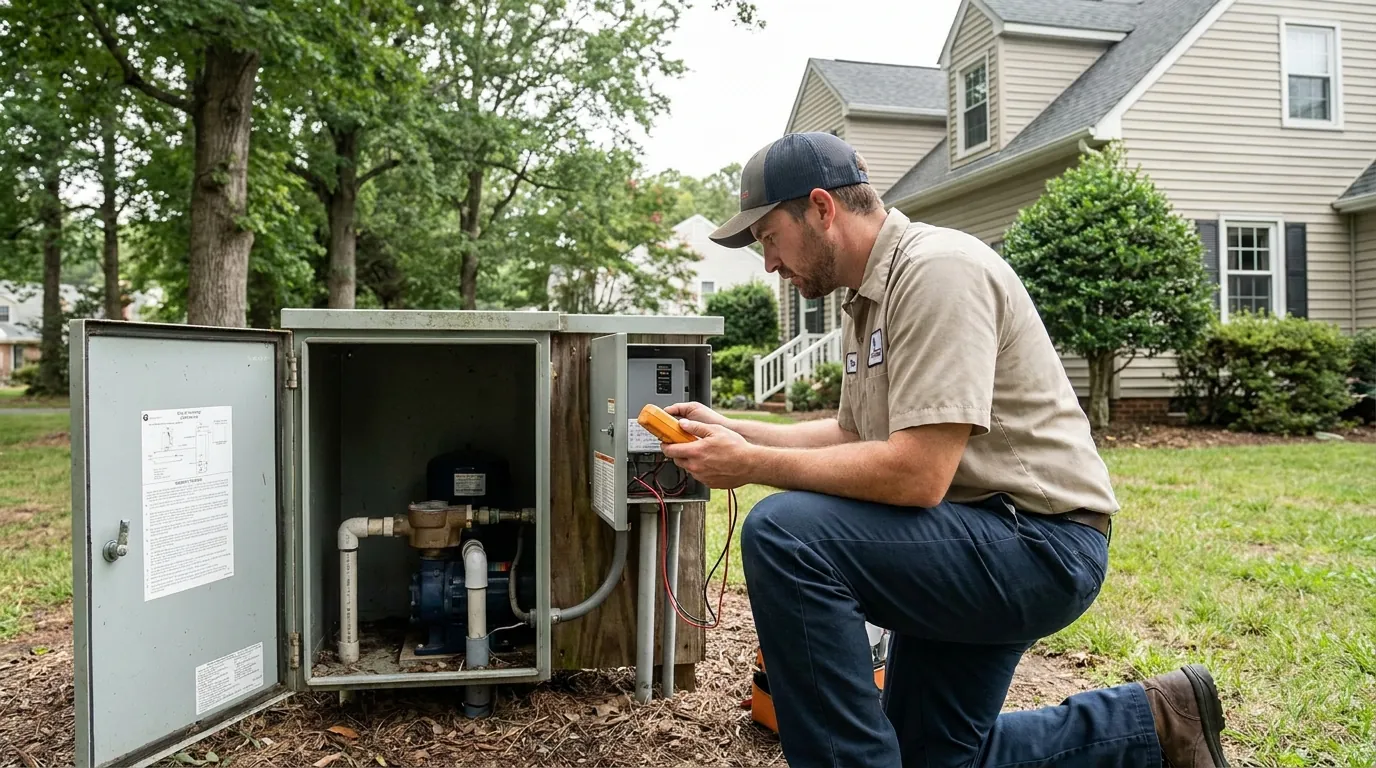
When you need well pump repair
Losing water from a private well is not a minor inconvenience — it stops showers, laundry, dishes, and everything else. Most well pump repair calls in Chesapeake start with one of a few symptoms: no water at all, water pressure that has dropped or fades under use, air sputtering from the faucets, or a pump that never seems to shut off. Each of those points to a different underlying cause, and a good repair starts by finding out which one you actually have.
It is worth knowing that a surprising share of 'dead pump' calls are not the pump. A tripped breaker, a corroded pressure switch, a failed capacitor in the control box, or a waterlogged pressure tank can all mimic a bad pump — and all are far cheaper to fix than pulling a submersible from the bottom of a well. That is why we diagnose before we quote. Careful diagnosis is also what separates a real repair from a guess, and it is a big part of what well pump work involves.
Chesapeake's climate plays directly into pump failures. Persistent humidity and wet winters corrode electrical contacts, while the region's clay soils and moving water table put stress on wells and lines. When a repair no longer makes sense — when the motor is worn out or the pump has failed repeatedly — we will say so and walk you through well pump installation instead of patching something on its last legs.
How we approach a well pump repair
Diagnosis first, so the fix actually solves the problem.
-
Confirm power and controls
We start at the surface: breaker, pressure switch, control box, and wiring. Many 'dead pump' calls are actually a tripped breaker, a corroded switch contact, or a failed capacitor — all common in Chesapeake's damp climate and far cheaper than pulling a pump.
-
Test the pressure tank
We check the tank's air charge and bladder. A waterlogged tank causes short cycling and low pressure and slowly destroys the pump motor. If the tank is the culprit, replacing it restores normal operation without touching the pump.
-
Diagnose the pump and well
If the surface checks out, we test the pump's electrical values and, when needed, pull the pump to inspect it. We look at motor condition, the impellers, the check valve, and how much sediment the well is producing — which tells us whether it's the pump or the well behaving badly.
-
Repair and verify
We replace the failed component, then verify the whole system: cut-in and cut-out pressure, cycling behavior, flow at the tap, and amp draw. We want the system stable and balanced before we leave, not just running for the moment.
How Chesapeake conditions change a repair
The humid air here is hard on the parts that live above ground. Pressure switches, control boxes, and wire connections corrode faster than they would in a dry climate, so on repair calls we spend real time on the electrical side — cleaning or replacing contacts and sealing connections against moisture so the same fault does not come back in a season.
Below ground, the red clay soils common across Chesapeake, Norfolk, and nearby areas hold moisture and shift with the wet-and-dry cycle of the seasons. That movement stresses casings and buried lines, and clay-borne sediment wears pump impellers and clogs screens. When we pull a pump, we look at how much grit the well is producing, because a pump that keeps failing is sometimes a symptom of a well that needs its own attention. If you have not had the system looked at in a while, our routine well pump service can catch these issues before they leave you without water.
Get your water back on
If you have lost water or your pressure is failing, describe what is happening and we will help you figure out the likely cause and the next step. We repair pumps, switches, tanks, and controls across Chesapeake and the surrounding area.
Call to reach us about a well pump repair anywhere in Hampton Roads.
Frequently asked questions
Is it always the pump when I lose water?
No, and that is why diagnosis comes first. Tripped breakers, failed pressure switches, bad capacitors, and waterlogged tanks all cause the same symptoms as a dead pump but cost far less to fix. We check those before assuming the pump has failed.
Why does my pump keep running and never shut off?
A pump that runs constantly is usually fighting a waterlogged pressure tank, a failing pressure switch, a leak in the line, or a well whose water level has dropped. Each has a different fix, so we test to find which one applies.
Can you repair the pump without pulling it out of the well?
Often, yes. When the problem is at the surface — switch, tank, capacitor, or wiring — we fix it without touching the submersible pump. We only pull the pump when the readings point to a fault in the pump or motor itself.
How do I know whether to repair or replace?
It comes down to the pump's age, condition, and history. A single failed part on an otherwise sound system is worth repairing; a worn-out motor or a pump that has failed repeatedly usually points toward replacement, and we will give you an honest read on which situation you are in.