Submersible Pump Service in Chesapeake
Submersible well pump service in Chesapeake, VA: diagnosing downhole faults, pulling and testing the pump, and restoring reliable water flow.
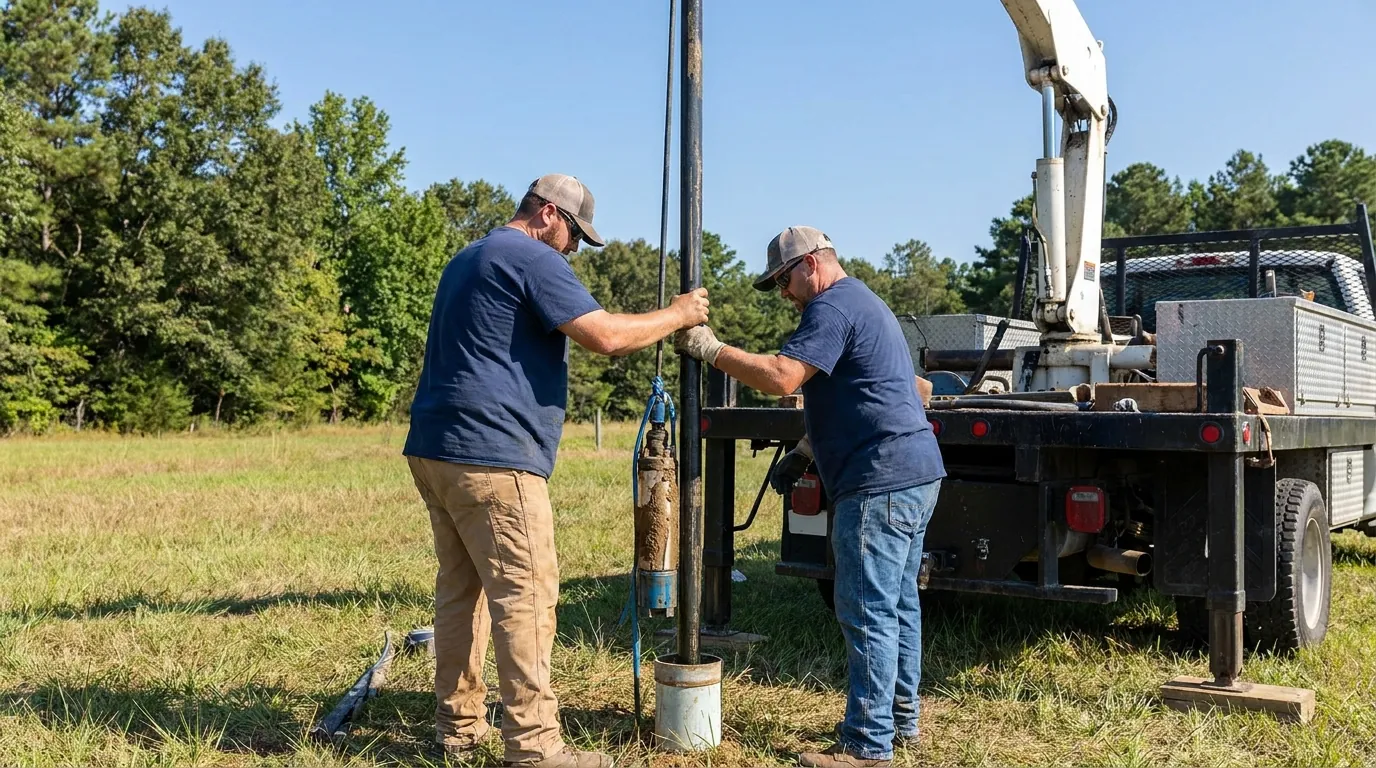
What makes submersible pumps different
Most deeper wells in and around Chesapeake use a submersible pump — a sealed unit that sits down inside the water column, pushing water up to the surface rather than pulling it from above. Because it's out of sight, a submersible gives little warning before it fails, and almost everything about diagnosing and servicing it depends on reading the system from the surface and, when needed, pulling the whole string out of the well.
Submersible trouble shows up as no water, pressure that collapses under demand, breakers tripping, air sputtering at the taps, or dirty water where there was none. These can stem from the motor, the drop wire, a leaking drop pipe, a failed check valve, or a water level that has fallen near the intake. The challenge is sorting a genuine pump failure from the many surface-side causes before anything is pulled, since lifting a pump from a deep well is the costly part of the job.
That's why submersible service starts with the same groundwork as low water pressure diagnosis and overlaps with well pump repair — rule out the cheap, surface-level faults first.
How submersible service is done
When the fault is confirmed to be downhole, servicing a submersible is a careful, step-by-step job:
-
Surface diagnosis first
We test the pressure switch, controls, capacitor, and drop-wire readings from the surface. Measuring insulation resistance and amp draw tells us whether the motor is the real problem before we lift anything.
-
Pull the string
If the fault is downhole, we draw up the drop pipe, wire, and safety rope together. Everything that comes out is inspected — the pump, the pipe, the splices, and the check valve all carry evidence of what went wrong.
-
Diagnose the pump
On the surface we confirm whether the motor, the pump end, or the wiring failed. Scale, sand wear, and corrosion tell us how the water has treated the unit and what the replacement should resist.
-
Service or replace
Where the pump end is sound and the fault is a splice, check valve, or wire, we repair it. Where the motor or pump has failed, we fit a correctly specified replacement unit.
-
Reset and test
We lower the pump to the proper depth above the well bottom, reconnect with waterproof splices, prime, and confirm pressure, amp draw, and steady flow before closing up.
How local water affects submersible pumps
Downhole, the submersible lives in whatever the aquifer provides, and Chesapeake's water is often mineral-rich and carries iron and fine sediment. That grit abrades the pump's impellers and stages over time and scales the check valve, so a submersible here can wear faster than one in clean water. When we pull a pump, the amount of scale and sand on it tells us a lot about how to spec the next unit for a longer life.
Well depth and water-table level shape the job as well. A high, seasonally shifting water table means the water level above the pump can change through the year, and a pump set at the wrong depth can either run dry during dry spells or sit too deep in sediment. Setting the pump at the right depth for the well — informed by the same depth and mineral factors that drive how a replacement is sized — is central to getting it right.
If a pulled pump is clearly finished, we'll explain well pump replacement and how the new unit's materials and depth should account for the local water, rather than simply dropping in a like-for-like swap.
Suspect a downhole problem?
Describe what your system is doing — no water, dirty water, tripping breakers, or fading pressure — and we'll help you figure out whether the trouble is at the surface or down the well.
Serving Chesapeake and nearby Hampton Roads communities.
Frequently asked questions
How do I know if my submersible pump has failed?
Common signs are no water at all, pressure that collapses under use, repeated breaker trips, or air and sediment at the taps. Because many of these also come from surface faults, we confirm with electrical and pressure tests before pulling the pump.
Do you always have to pull the pump to fix it?
No. Many problems blamed on a submersible are actually a pressure switch, capacitor, tank, or wiring issue at the surface, which we fix without lifting anything. We only pull the string when the fault is confirmed to be downhole.
Why does sediment or dirty water appear with a submersible?
It can mean the water level has drawn down near the intake, pulling in sand, or that a worn pump is stirring sediment. In mineral-heavy local water it may also be iron and scale breaking loose. Each has a different fix, so it's worth diagnosing.
Can a submersible pump be repaired, or only replaced?
It depends on what failed. A bad splice, check valve, or drop wire is repairable, and a sound pump end can sometimes be serviced. A failed motor or a worn pump end usually means replacement, which we'll explain plainly once the unit is out and inspected.