Pressure tank and air charge
We check the tank's pre-charge and bladder. A waterlogged tank makes the pump cycle on and off rapidly, which wears the motor out early. Setting the charge right is one of the simplest ways to extend pump life.
Routine well pump service and system checks for Chesapeake, VA homes. Catch small problems before they become no-water emergencies.
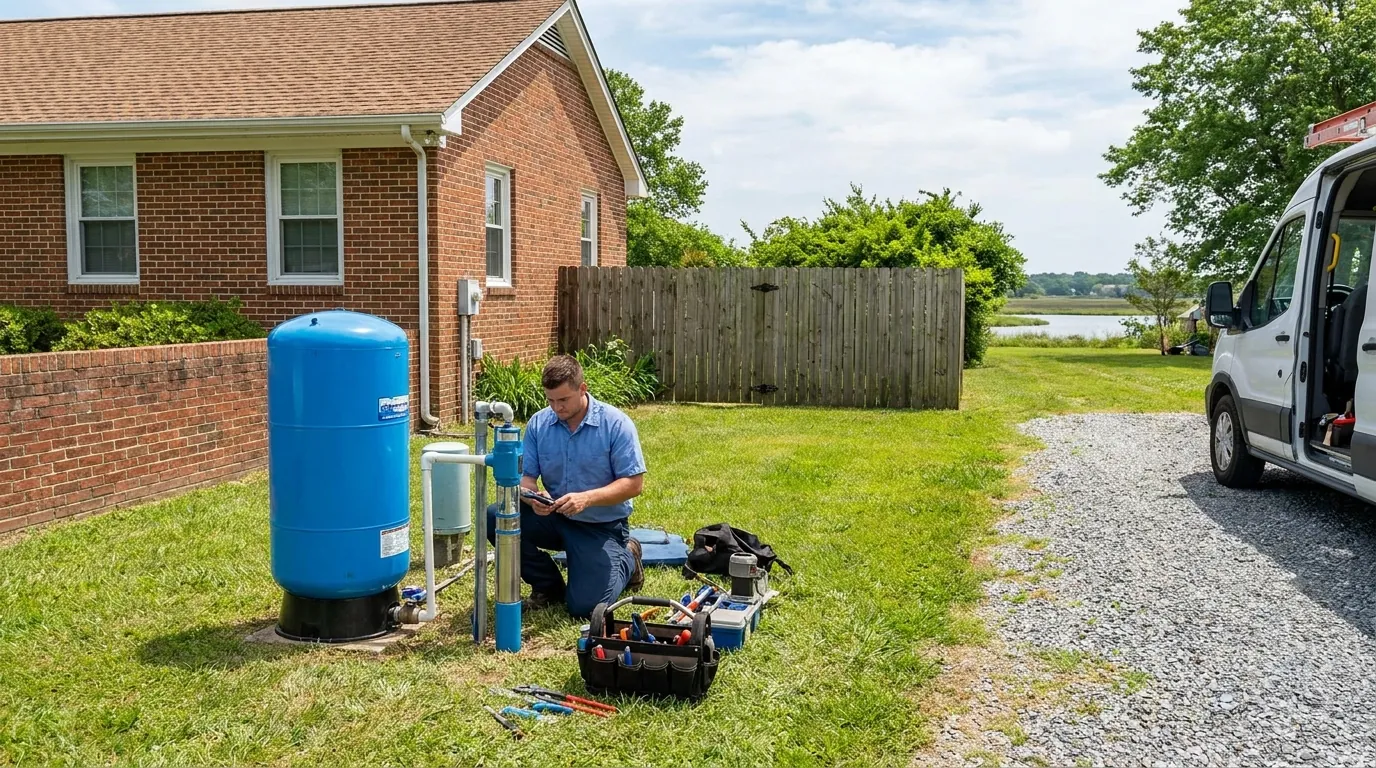
If your Chesapeake home draws water from a private well, the pump is the one piece of equipment standing between you and no water at the tap. Most homeowners never think about it until pressure drops, the water sputters, or the pump starts running constantly. Regular well pump service is about finding the early warning signs — a weakening motor, a waterlogged pressure tank, a corroding pressure switch — while they are still cheap to fix.
The conditions around Chesapeake work against well equipment in specific ways. Humid summers and wet winters keep control boxes, switches, and above-ground wiring damp for months at a time, and damp electrical contacts corrode and fail. The area's red clay soils hold water and shift with the seasons, which can stress well casings and buried lines. And a shifting coastal water table means a pump that ran fine all spring can start struggling when levels drop in a dry stretch. Service visits are how those seasonal changes get caught before they strand you.
Well pump service is different from an emergency repair. It is planned, unhurried, and preventive. If we do find a fault, we can move straight into well pump repair; and when a pump has simply reached the end of its life, we can talk through well pump installation before it fails on a holiday weekend.
A thorough check-up looks at the whole system, not just the pump itself.
We check the tank's pre-charge and bladder. A waterlogged tank makes the pump cycle on and off rapidly, which wears the motor out early. Setting the charge right is one of the simplest ways to extend pump life.
The switch and control box are where Chesapeake's damp air does the most damage. We inspect contacts for corrosion and pitting, confirm cut-in and cut-out pressures, and look for signs of arcing before they cause a failure.
We measure voltage and amp draw against the pump's rated values. A motor pulling too many amps is heading toward failure, and catching that early often means a planned replacement instead of a middle-of-the-night outage.
We test flow at the taps and watch for sediment, air, or pressure that fades under demand — clues that point to the pump, the well, or a leak in the line.
Because the water table around Chesapeake and neighboring communities like Suffolk and Portsmouth moves with rainfall and the seasons, we pay attention to how a well behaves under sustained demand, not just at the moment we arrive. A pump that draws air or loses pressure only after ten minutes of running is often telling us the water level is dropping faster than the well recovers — something a quick glance would miss.
Sediment is another local factor. Wells set in clay-heavy ground can pull fine grit that wears impellers and clogs screens over time. We note how much a system is producing so we can advise on whether the pump is simply aging or the well itself needs attention. All of this feeds a plain recommendation: leave it alone, adjust it, repair it, or plan to replace it.
If your water pressure has changed, your pump runs more than it used to, or it has just been a few years since anyone looked at the system, a service visit is the cheapest insurance you can buy for a private well.
Call to arrange a visit anywhere in Chesapeake and the surrounding Hampton Roads communities.
A yearly check is reasonable for most Chesapeake households, especially given how the local humidity works on electrical parts. Homes with older equipment, heavy water use, or a history of sediment may benefit from more frequent visits.
Watch for dropping or fluctuating water pressure, air spitting from the taps, a pump that runs constantly or cycles rapidly, and higher electric bills. Any of these is worth a look before it turns into a total loss of water.
Yes. Most premature pump failures trace back to a waterlogged pressure tank or a failing switch that made the motor overwork. Correcting those small problems during a service visit takes real strain off the pump.
We explain what we found in plain terms and what the options are. Depending on the issue, that may mean an on-the-spot repair, a planned part replacement, or a conversation about eventually replacing the pump.